The Four Stages of Sleep
Sleep isn't one state — it's four distinct stages, each with its own brain activity, purpose, and duration. Understanding them is what makes the 90-minute sleep cycle make sense.
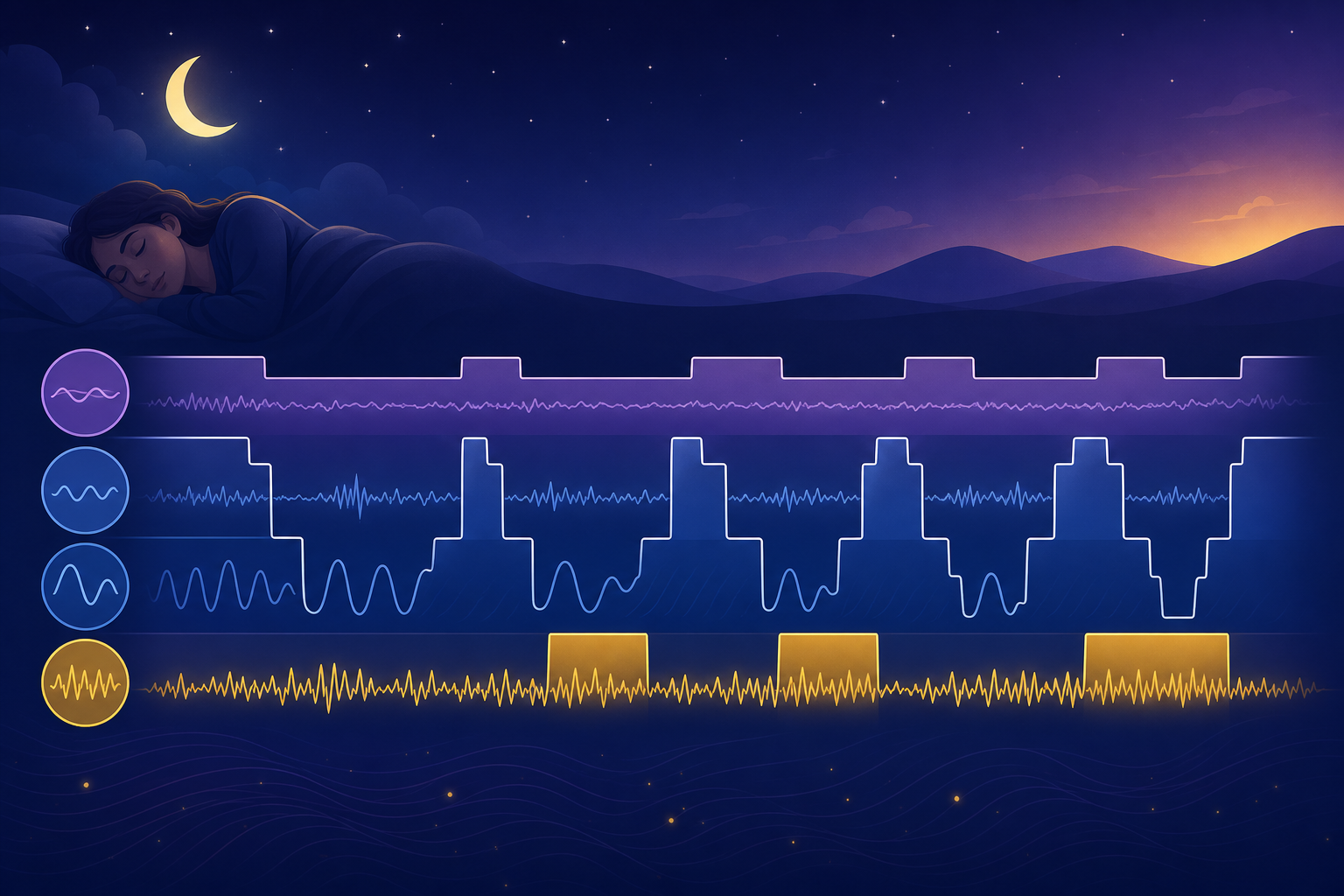
The four stages
You cycle through all four stages multiple times each night, in this order. Each complete cycle takes roughly 90 minutes.
NREM Stage 1 (N1) — light sleep, ~5%
The transition between awake and asleep. Your breathing slows, muscles relax, and brain waves shift from alpha (alert) to theta (drowsy). Easy to wake from — a noise or movement will pull you back. Lasts 5–10 minutes per cycle. This is the stage you can be roused from by your name being called.
NREM Stage 2 (N2) — light sleep, ~45%
The biggest chunk of your night. Brain waves show characteristic sleep spindles (brief bursts of activity associated with memory consolidation) and K-complexes (the brain's response to external stimuli while staying asleep). Heart rate drops, body temperature falls. You're asleep but not deeply — still easy to wake, though it takes more stimulus.
NREM Stage 3 (N3) — deep sleep, ~25%
Also called slow-wave sleep because of the high-amplitude, low-frequency delta waves on EEG. This is the physically restorative stage — tissue repair, immune system activation, growth hormone release. Hardest to wake from. If you've ever tried to rouse a deeply sleeping teenager, this is the stage.
REM sleep — ~25%
Rapid eye movement. Brain activity is almost identical to wakefulness on EEG — your brain is essentially running its daytime processing tasks overnight. Heart rate and breathing become irregular. Most vivid dreaming happens here. Muscles are paralysed (a feature, not a bug — prevents you acting out your dreams).
How stages shift across the night
In the first half of the night, you spend more time in N3 deep sleep. By the second half, REM gets progressively longer — your last cycle of the night might be 50%+ REM. This is why:
- Cutting sleep short hits REM harder than deep sleep. You lose more dreaming and memory consolidation than physical recovery.
- Older adults get less N3 than young adults — deep sleep decreases with age, which is one reason recovery from physical exertion gets harder.
- Alcohol suppresses REM in the first half of the night. You may sleep 8 hours but wake with worse cognitive function than if you'd slept 6 sober.
Why this matters for the calculator
The 90-minute sleep cycle works because waking between cycles — when you're in light N1 or N2 — is dramatically easier than waking inside a cycle, particularly out of N3 deep sleep. The calculator times your alarm to those boundaries.
Related: what sleep inertia is, how many cycles you need, or jump back to the calculator.